
EXPERIMENTS
In this section, I present two experiments that suggest:
- The speed of light is not absolute.
- The Earth’s gravitational field rotates.
The first is an experiment carried out indirectly by NASA. It concerns the HST (Hubble Space Telescope). The telescope was, of course, not intended as an experiment, but it indirectly demonstrated that the speed of light in the vacuum of space is not absolute with respect to the velocity of the space telescope.
Note: The same is suggested by the phenomenon of stellar aberration (Fig. 1), discovered by the English astronomer James Bradley (1727). From the figure, which is an interpretation of the description of aberration from the Encyclopedia of Astronomy, it is evident that the motion of the Earth affects the direction of observation of ground-based telescopes. When observing with terrestrial telescopes, we must consider not only the orbital velocity of the Earth, but also the rotational velocity of the Earth. The use of the vector sum of light velocities implies that the speed of light is not absolute.
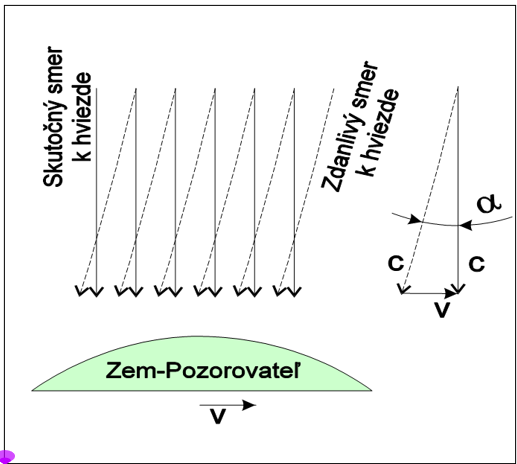
Fig. 1 Stellar aberration – Encyclopedia of Astronomy (1987, Obzor – Bratislava).
The second is the DOGA (Direction Of Gravity Acceleration) experiment, which we initiated in 2002 and which continues to this day. At the beginning, the experiment was focused on determining the propagation speed of gravity. We assumed that the optical and gravitational positions of the Moon might not be identical.
We designed an experiment intended to monitor the positions of the Moon and the Sun gravitationally rather than optically. The difference between the optical and gravitational positions was expected to help answer the question of the speed of gravitational action. In the case of the Moon, we assumed that the extreme position of the pendulum would shift by approximately 15 degrees each day.
In the faculty laboratory, we used inductive sensors manufactured in the former East Germany to measure the geometric accuracy of machine tools. When measuring distances in the range of one to two millimeters, they achieved a sensitivity of one tenth of a micrometer. The sensor was positioned at a distance of 1 mm from a rigidly fixed metal object and connected into a Wheatstone bridge (Fig. 2). After balancing the bridge and connecting it to the measuring computer, it was necessary to calibrate the position changes indicated in mV. Unfortunately, after three days, the bridge became unbalanced due to changes in the magnetic field around the sensor. This meant that the measurement had to be restarted.
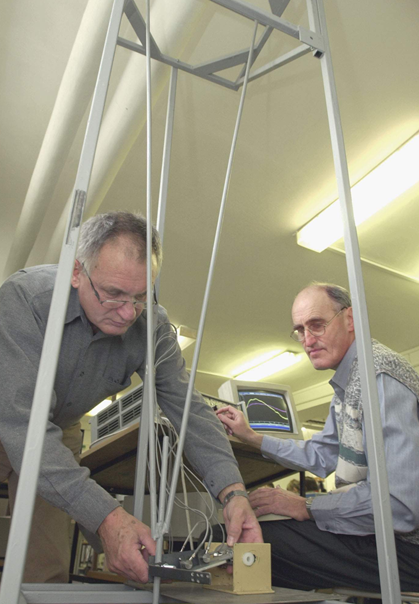
Fig. 2 Adjustment of the inductive sensor on the measuring tower.
The first measurements were already successful. However, the recorded pendulum position corresponded to the influence of the Sun’s position. In 2003, we published an article in the journal Kybernetes entitled “The Measurement of Speed of Gravitational Wave.”
Press conference report (2003)
We continued the measurements while simultaneously searching for a more suitable location where more precise data could be obtained. It should be emphasized that the experiment was not our main occupation — we devoted ourselves to it only in our free time.
For several years, we tested various locations for the measuring equipment. We attempted to find a site as protected as possible from external influences. At the same time, we searched for a pendulum position sensor that would not require calibration and would be capable of continuously recording data throughout the entire year.
In 2012, we succeeded in obtaining a TONIC laser sensor from the English company RENISHAW and found a suitable location outside urban areas, where disturbing influences were minimized.
Construction of the measuring site
During the full Moon in February 2019, we recorded a surprising influence of the Moon. This effect was detected by both TONIC laser sensors. The sensor monitoring changes in gravitational acceleration in the north–south direction detected the Moon’s influence approximately one day earlier than the second sensor, which monitored changes in the east–west direction.
We were surprised not only by the moment when the sudden change in the direction of acceleration began (the Moon was still below the horizon at that time), but also by how long this influence lasted. The gravitational acceleration returned to its original direction only after a prolonged period. From the beginning to the end of the Moon’s influence, nearly 10 days elapsed. A detailed description of the measuring site and the recorded data is provided in the DOGA submenu.
Link for online monitoring of the direction of gravitational acceleration
Based on the analysis of changes in the direction of gravitational acceleration, we arrived at the following conclusions:
- The duration of the Moon’s influence on the direction of gravitational acceleration demonstrates that the Earth’s gravitational field possesses not only a radial component, but also an orbital component (it rotates).
- The existence of the orbital component of the Earth’s gravity is evidence that the essence of gravity is the flow of an unknown substance.
These findings are described in detail in the DOGA menu section.